

After visiting the site of the thermae, I walked to the main (and more famous) site of Lugdunum, with the Roman Theatre, the Odéon, and the Gallo-Roman Museum (and some other interesting things).
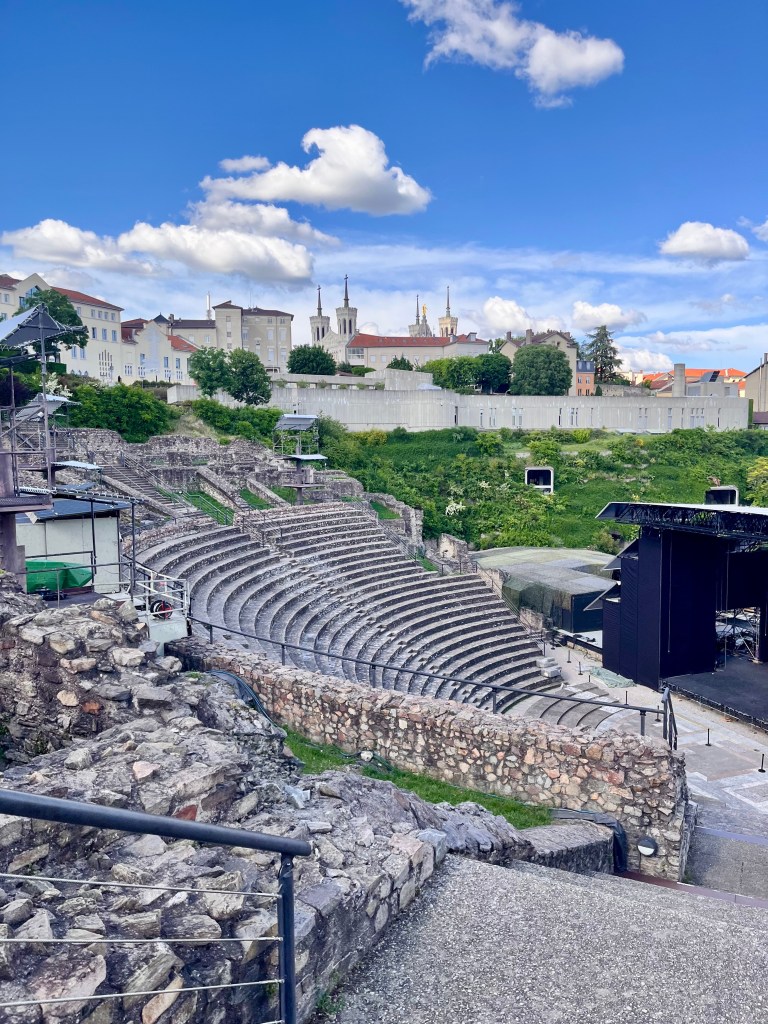
From far you can already see how impressive and complex this site is, the social, cultural and political center of Lugdunum. The theatre and the odeon are incredible, very well preserved and still hosting events (in fact, while I was there, they were setting up for the Nuits de Fourvière festival, during which several performances take place in the site).
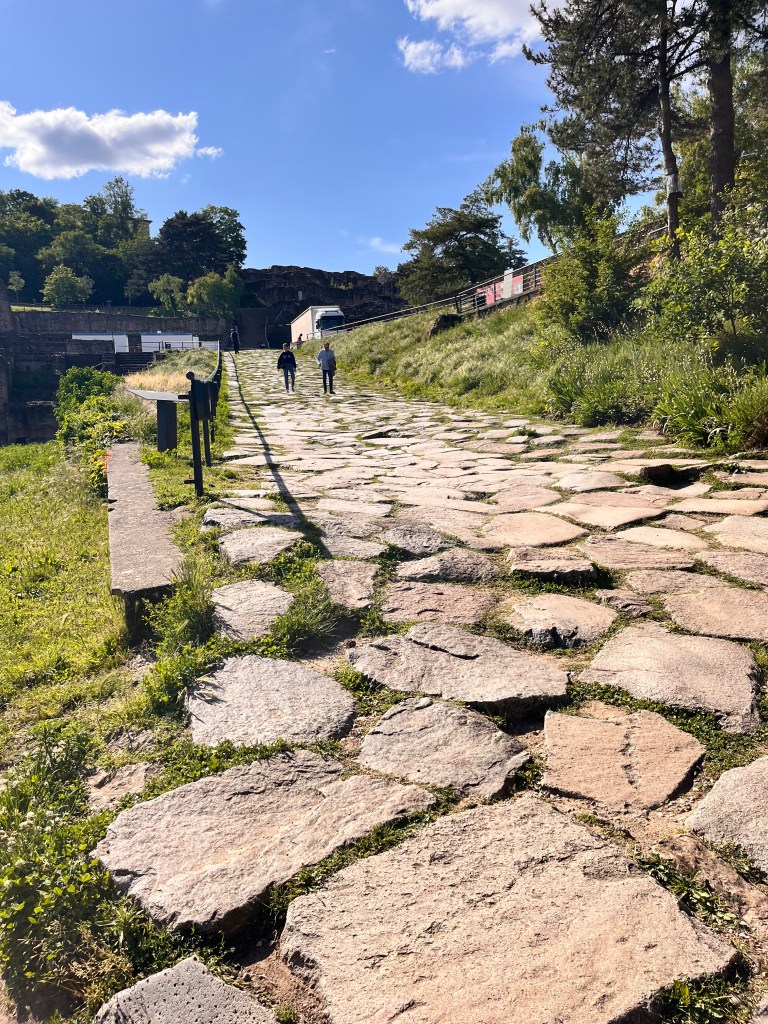
The Odéon and the Théâtre
The Odéon is a smaller version of the Théâtre, and it was used for more intimate performances such as poetry readings. Interestingly, the ruins of the Odéon remained visible since Antiquity, while the Théâtre had vanished from sight. For a long time, people believed the Odéon was the Théâtre, and it wasn’t until the 1930s, when efforts to locate traces of Christian martyrs, the Grand Théâtre was uncovered. Originally built under Augustus in 15 B.C., it could hold around 5,000 spectators. It was later expanded under Emperor Hadrian, around 120 A.D., to accommodate up to 10,000. Today, it stands as the oldest known theatre in all of Gaul.

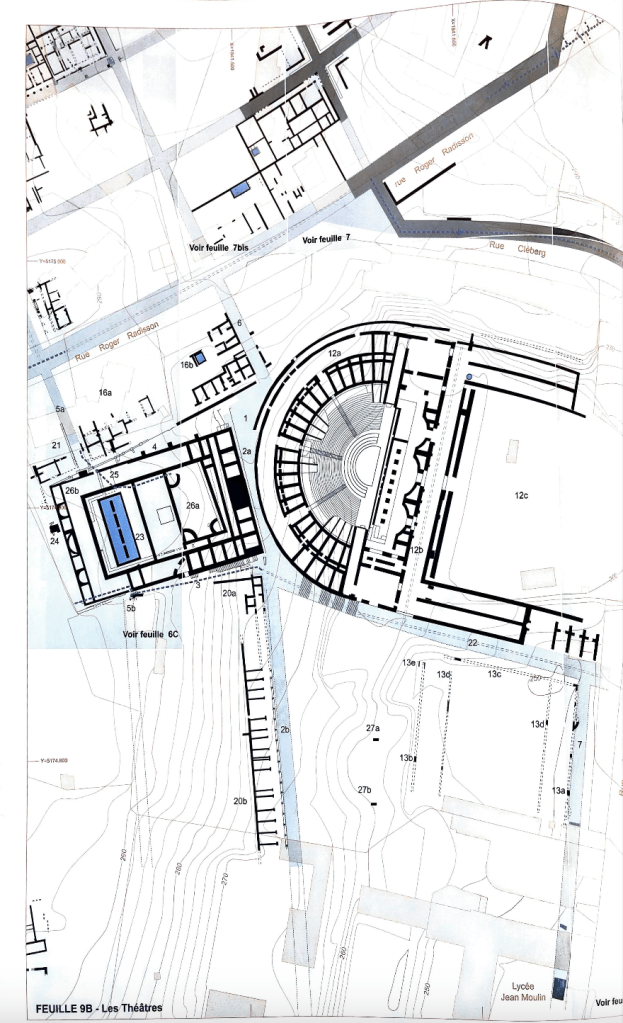
As interesting as these two large buildings are, in this visit I was very interested by the ruins of other buildings around them, especially the big rectangular building(s) next to Theatre, and the row of buildings next to the Odeon (lower part of the map below).
The mysteries of Cybele
The rectangular building is often referred to as the “Pseudo-sanctuary of Cybele,” a name that dates back to the 18th century, when a taurobolic altar — that is, an altar used for bull sacrifices — was discovered and linked to Cybele, the mother of the gods. At the time, it all seemed very clear: the altar commemorated a ritual held in 160 AD under Emperor Antoninus Pius, so naturally, it was assumed the building was part of her cult site. But there was a problem: it was unclear where exactly the altar had been found, and archaeologists spent the next couple of centuries debating if indeed this was it.
Things got harder for the Cybele theory in the second half of the 20th century. Additional research carried out by Amable Audin (who was involved in the creation of the Gallo-Roman Museum of Lyon) proposed a more complex narrative for the occupation of the site, naming it Insula basilicale – but still considering the presence of a Sanctuary to Cybele.
This theory was definitively ruled out only after excavations in 1991, which confirmed that it had been constructed much earlier, around 10 AD, during the late Augustan period. The 160 AD altar remains the earliest known evidence of the cult of Cybele in Gaul, making it highly unlikely that the goddess was already worshipped in Lugdunum at the time the structure was built. Scholars now believe the cult of Cybele was introduced to Gaul only later, possibly during the reign of Claudius (41–54 AD).
If not a temple, what could it be?
Today, the agreement is that the occupation happened in three phases: early houses, then a palace and a basilique, and finally a building whose use is still unclear. Several hypotheses have been raised for this mysterious building:
- A college of Augustales (priests dedicated to the Emperor cult), a schola (a sort of market to as specific corporation)
- A macellum (a market focused on the sale of food products)
- The barracks for the vigiles urbani (a sort of firefighters),
- And, finally, the hypothesis of a sanctuary has not been completely discarded; but if that is the case, it seems unlikely to be for a western deities such as Cybele, most probably oriental ones due to the atypical organization of the rooms.
In the back, a cistern (or reservoir) received water that supplied the hill of la Fourvière. This cistern has been suggested as evidence for the hypothesis of the barracks for the vigiles urbani, as they would have easy access to water to conter fires. (cf. Desbat et Savay-Guerraz, Lenobre (dir), pp. 370/1)
In the photos below, we see the building from two different angles: on the left, a lateral view from the top of the ancient road that once connected it to the Theatre; on the right, a frontal view of the structure (where the two men are standing). My impression was that it must have looked rather grand: a solid rectangular block with four columns rising above, giving it a monumental presence.

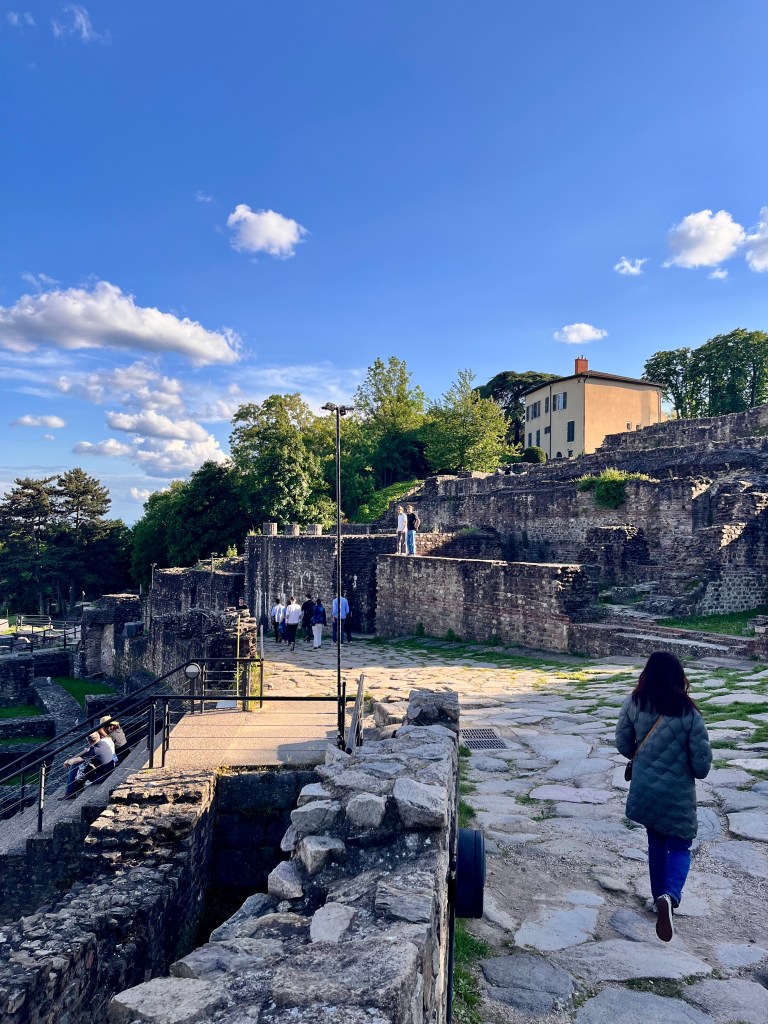
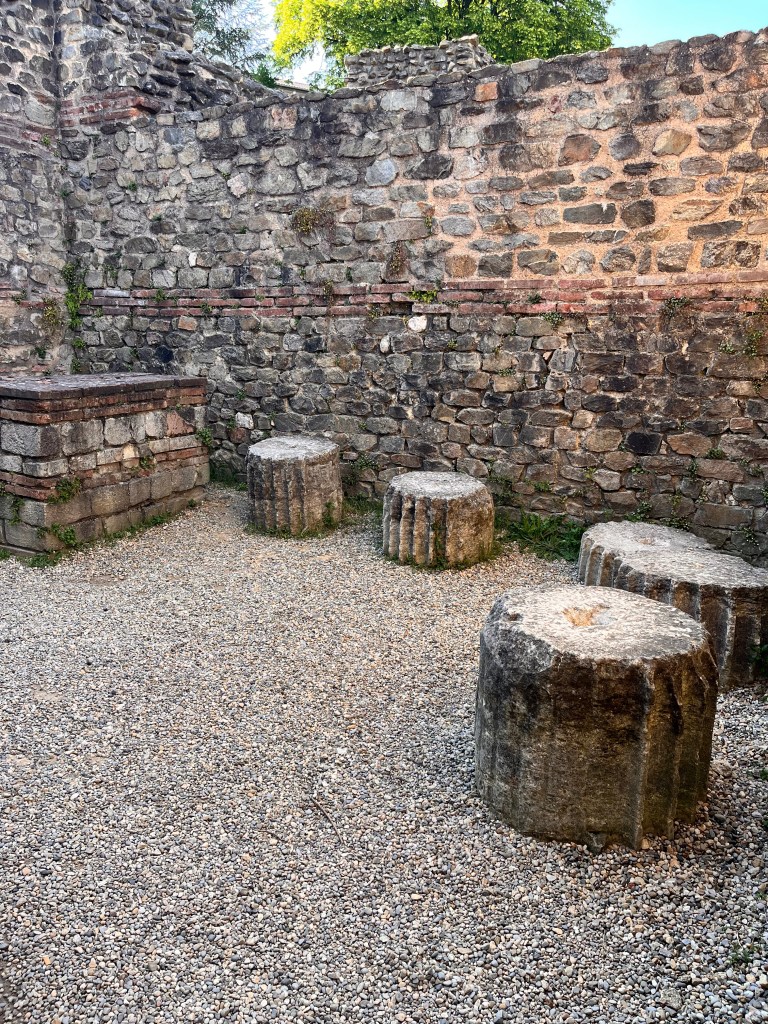
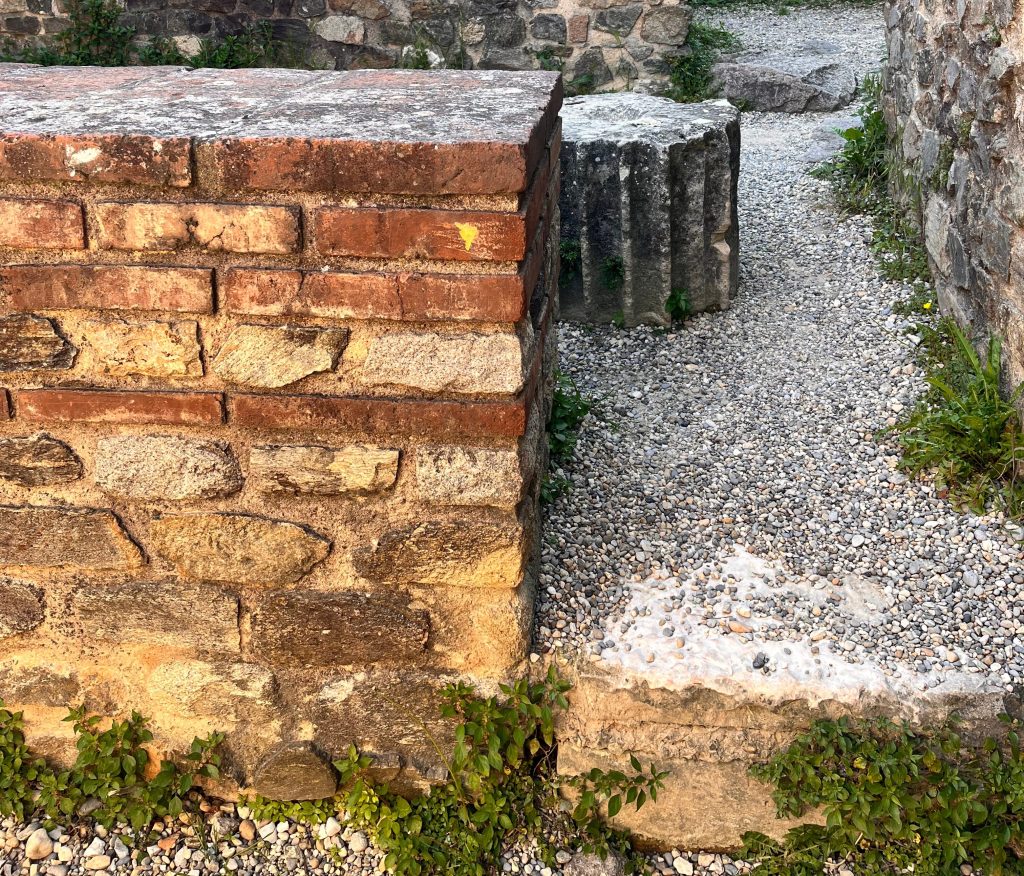
I entered the building and tried to imagine what was it structure. I found very interesting that there is a symmetry in the way it’s arranged, with two side rooms that follow a similar arrangement of columns. The structures in front correspond to seven shops, and the columns seem to belong to the peristylum of the praetorium in the second phase of the site (cf. Le Mer and Chomer p. 563).

The Theatre Road
After exploring other parts of this building, I walked south down the old road (the Theatre road) towards the back of the Odéon, where a row of insulae (houses) and stores once stood. Information on the site indicated that these buildings had been already demolished and reconstructed, as they were part of a neighborhood that was reorganized for the construction of the Odéon in the 1st century AD.

Some columns were left standing.


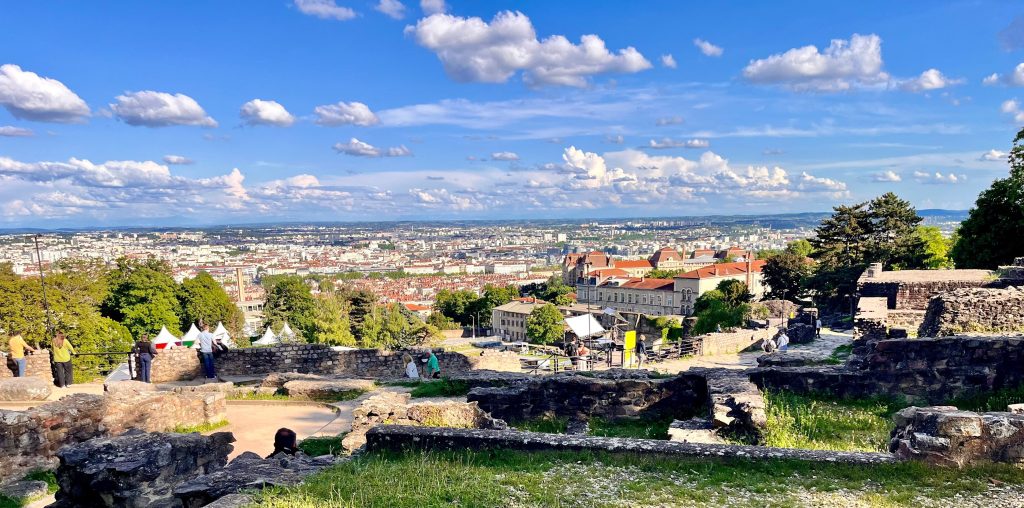
I walked back up the Road of the Theatre and climbed up to the ‘Pseudo-sanctuary of Cybele’ to read some (Roman) historical fiction while overlooking Lyon and the Alps in the distance.

Life in Lugdunum is good.
References:
Anne-Catherine Le Mer et Claire Chomer. Lyon – 69/2. Carte archéologique de la Gaule. Paris: Académie des Inscriptions et Belles-Lettres, 2007.
Aldo Borlenghi and Éric Leroy. “Alimentation et gestion de l’eau sur la colline de Fourvière à Lyon : les aménagements hydrauliques, la ville et ses monuments.” Gallia, vol. 80, no. 1, 2023. https://journals.openedition.org/gallia/8635#tocto2n8
Armand Desbat et Hugues Savay-Guerraz, « Feuille 9, Les Théâtres », dans Michel Lenoble, Atlas topographique de Lugdunum.
Bravard, Jean-Paul, Armand Desbat, Anne Pariente, and Hugues Savay-Guerraz. Lyon antique. Paris: Éditions du Patrimoine, 2012.
Morgane Andrieu, Armand Desbat, and Michel Feugère. “Aspects de l’écriture sur le site du pseudo-sanctuaire de Cybèle, à Lyon (43 av. à 15 de n.è.).” Revue archéologique de l’Est, vol. 70, 2021. https://journals.openedition.org/rae/14800
 Archaeo Notes
Leave a comment